
What do you do when the job market is more uncertain than ever before?
You’ve been told to bury yourself in extracurriculars and attend every networking event—but that’s easier said than done. What is the perfect balance of experience and connections to land your dream job? And what if networking was something you could fit into your everyday routine?
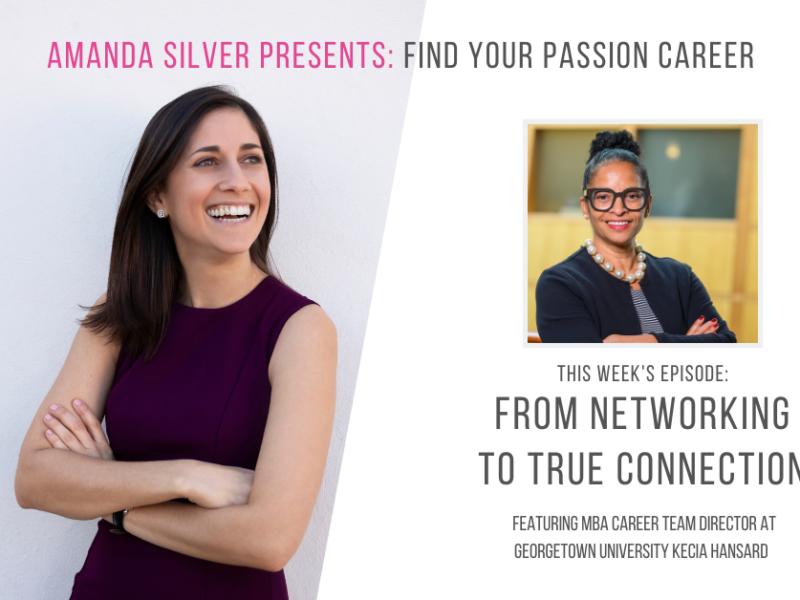
Kecia Hansard is a director of the MBA Career Team at Georgetown University’s McDonough School of Business and a career coach. She advises MBA students and helps build relationships between employees and employers, making her an expert on getting hired. Additionally, she teaches young professionals how to market themselves no matter the job market’s conditions.
In my conversation with Kecia, we talk about viewing networking as casual conversation, drowning out the noise of the competition, and acing dreaded interview questions. Kecia wants you to remember the importance of your unique value in the career search process. She says, “Don’t think about other people. Focus on your why.”
Tune into my conversation with Kecia Hansard to learn more about securing your dream job on the Find Your Passion Career Podcast!
On Storytelling
Kecia wanted to be a dance major in college, but she made a deal with her father to major in journalism as well. As she juggled classes in both majors, performed in musicals, and wrote articles for student publications, she discovered that they were connected. Both dance and journalism were two mediums for telling a story. And since then, storytelling has been the thread throughout Kecia’s career journey.
“Being a storyteller academically allowed me to think about research [and learn how] to dig into and find details, which has really helped me in working with students,” she says.
Because of her storytelling background, Kecia can investigate job opportunities and companies differently than most. For example, she often prompts students to think, “‘Where else does this job show up? How does this industry map out, or where are the markets where I can fit in?’”
By looking at the story you’re telling, you may discover that there’s more than one career that’s the right path for you.
On Networking
Kecia wants to debunk the assumption that networking can only happen at career fairs or networking events. Instead, she believes that networking can happen anywhere, so long as you’re willing to make a genuine connection with another person.
“If you can prove that you’re helpful when nobody is asking you for anything, that’s when people will remember you,” she says.
Kecia notes that some of her best networking has happened when strangers ask her for pens at cafes, or during flight delays at airports. To her, networking doesn’t have to be inherently stressful.
Kecia also believes that networking can be done for other people’s sake.
Once, while shopping, Kecia noticed that her cashier’s water bottle had a logo of a company that had recently posted on her school’s website. Striking up a conversation, she learned that the cashier had interned for the company and got information about his experience, which she could relay to her students.
The next time you’re at Trader Joe’s, strike up a conversation with the people around you. You never know what relationships you could build through casual conversation.
The Three “Why” Framework
According to Kecia, intentionality during the job search is key.
She recommends reaching out to current employees, people in your network, and career center staff rather than applying blindly. If not, you may miss valuable information. For example, industries such as banking and consulting have standardized hiring cycles.
Kecia warns that finding jobs on LinkedIn and applying isn’t enough anymore, especially in such a competitive job market. However, this shouldn’t discourage you.
“Don’t think about the other people in line at a career fair. Don’t think about whoever else is on LinkedIn. Don’t think about the person who’s at another school,” she says. “Focus on your great skills and your rationale—your why.”
What, exactly, is that why?
Kecia instructs her students to ask themselves three questions during the job search process: “‘Why this industry? Why this organization? Why this role?’” If you can’t quickly answer these questions, some reevaluation might be needed.
Kecia’s framework isn’t limited to the job search process, however. If you’re applying for any role or program, asking yourself these questions could give you some much-needed clarity. Give it a try!
Reframing Tricky Questions
Everyone hates it when interviewers ask about your weaknesses, failures, or anything that requires vulnerability. However, Kecia believes these questions are important.
“Employers are looking and hoping for vulnerability,” she says.
However, Kecia notes that when interviewers ask about failure, they actually want to hear a story about your growth. According to her, if you talk about your positive qualities but end by discussing failure, it’s like taking the interviewer on a one-drop roller coaster—they leave unimpressed and dissatisfied.
“I’d reframe it as, ‘What is something you’re working on? Share how you’re doing that,’” she says.
Employers aren’t looking for perfect team members; they focus on people who can be honest about their failures and show how they’ve grown from them. Practice storytelling around some of your weaknesses or failure experiences, so you’re prepared for those lightning rounds.
The Rejection Shot
Kecia is no stranger to rejection.
After being laid off from a previous job, she went through a lengthy period of applications and rejections. Instead of wallowing in her sorrow, a college friend recommended that she take a run around her block each time she was rejected.
Unfortunately, Kecia got this advice in the middle of the summer. So, she modified that advice and came up with “rejection shots”—small bursts of physical activity that can take your mind off your current circumstances.
“It’s good to have a collaborator who will make a suggestion to change up your energy,” she says. When you face rejection, make sure to take care of yourself. Recovery is inevitable, so don’t panic over things you can’t control.
After listening to Kecia’s story, one lesson is clear: tune out the competition and focus on your unique experiences, talents, and strengths. To tune into the full interview, download the episode here on Spotify or Apple Podcasts.
 FYPC Podcast Ep. 69: Dr. Kristin Scott, Management Professor at Clemson University and Researcher