
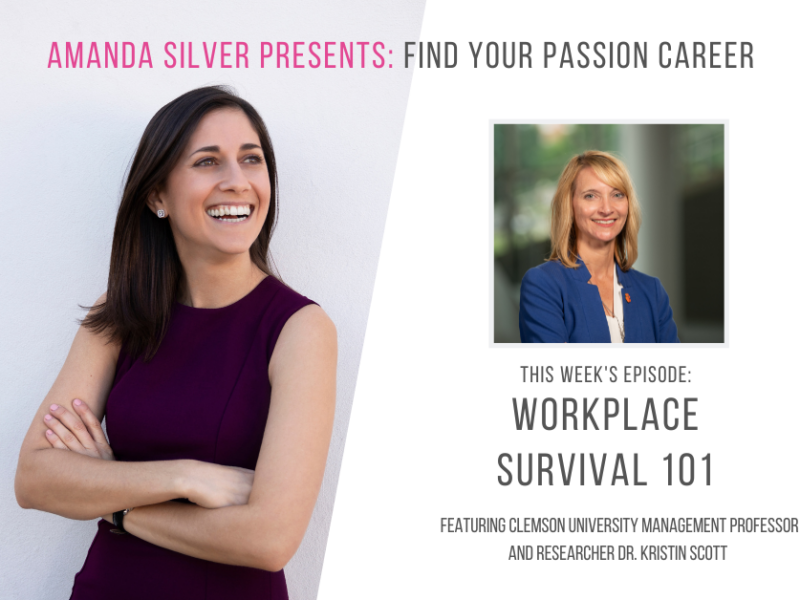
What do you do when you face rejection at work? Do you mentally check out or complain to your inner circle, or do you take it in stride? Imagine if rejection didn’t ruin our workplace experience or harm our motivation.
Dr. Kristin Scott is a management professor and the director of the Executive Leadership PhD Program at Clemson University. Her research focuses on workplace dynamics, including employee motivation and workplace exclusion. She uncovers what makes offices functional (and dysfunctional), then provides evidence-based strategies that can help you thrive at work.
In my conversation with Kristin, we talk about how to handle workplace dysfunction, the qualities of effective workplace leaders, and the importance of hopefulness after facing rejection. Kristin wants you to see rejection as a lesson instead of a condemnation. She says, “Rejections teach us a lot about resilience and hope.”
Tune into my conversation with Kristin Scott to learn more about thriving in the workplace on the Find Your Passion Career Podcast!
On Professionalism
Kristin’s interest in workplace dynamics stemmed from her experience in human resources. While working as an HR professional in corporate America for a decade, she noticed that unprofessionalism was common, even among company higher-ups.
“We’d say, ‘This is a professional setting, so behave accordingly,’” she says. “Yet there were many instances where people were behaving badly, and, of course, HR had to intervene.”
Kristin wasn’t immune to this bad behavior. At her first job after graduate school, she was interviewing candidates for an entry-level office position, and things went awry.
“After some of the interviews, a dozen roses showed up at the front desk of the workplace,” she says. “I was somewhat mortified.”
Suffice to say, the candidate who sent her the flowers didn’t get the job (though this incident wasn’t the sole reason).
Unprofessionalism affects everyone involved and can leave a lasting impression. If you want to contribute to a positive workplace culture—and protect your reputation—bring the best version of yourself to work. Don’t do anything you wouldn’t want to go viral on TikTok.
On Workplace Dysfunction
When Kristin transitioned into academia, a question that stayed on her mind was, “Why do people behave dysfunctionally in the workplace?” Her research and others’ have found a root cause: fear.
According to Kristin, when people feel threatened in the workplace, they go into self-protection mode, which manifests as a need for control. This can also lead to envy, exclusion, abuse of supervision, and other issues.
Kristin notes that these feelings aren’t abnormal since our brains are hardwired to focus on danger and potential harm.
“The reality is the workplace is full of competition, and it’s our livelihood,” she says. “I don’t think we’ve had a lot of education about how to manage that.”
So, if you think your workplace is dysfunctional, what should you do?
Kristin recommends three steps, adapted from Crucial Conversations, a book she recommends for her HR students.
Step 1: Be self-aware
Ask yourself if you play a part in the dysfunction and reevaluate your mindset.
Step 2: Build trust with the person who is being dysfunctional
“Try to figure out, ‘What is the fear to which that person is reacting? What are these actions actually representing?’” Kristin says.
Kristin recommends trying to build a positive relationship with the other person, since you will have to continue working with them.
“If you have nothing else, just recognize that this is another human being,” she says. “At the end of the day, if you truly want to make the situation better, you’re going to have to keep at it.”
Step 3: Remember that nothing lasts forever, even the most difficult situations
So, should you stay in dysfunctional workplaces no matter what?
“If dysfunction’s a pervasive culture, you might need to leave,” Kristin says. “It may not be worth your sanity.”
Kristin’s research shows that people internalize the stress of dysfunctional workplaces, which negatively affects themselves, their health, and their family relationships. However, if only a few people in the workplace are dysfunctional, she recommends sticking it out.
“In reality, it’s just work, and work is hard,” she says.
No workplace is perfect, but you shouldn’t accept chaos just because you’re employed. Keep an eye out for warning signs but remember that a little communication can go a long way.
Hold on to Hope
Kristin’s latest research on positive organizational scholarship has made hope a core value for her.
“Hope is saying, ‘I believe I have a better future ahead as long as I follow this path,’” she says.
Hope is often confused with optimism, according to Kristin. Optimism is a positive expectation without any need to act, that things will turn out well, no matter what. But hope involves agency.
“It gives us our control back and reminds us that nothing negative lasts forever,” she says.
Kristin and other researchers conducted a study on mindfulness during the COVID-19 pandemic that demonstrated the importance of hope. Workers in the performing arts who felt hopeful despite the challenges the pandemic brought to their industry were more resilient.
“Hope set in motion more positive, energized feelings and increased their willingness to stay engaged,” she says. “They also reported lower distress levels and overall better levels of well-being.”
Think of some ways you can remain hopeful in light of career setbacks.
On Rejection
Kristin is no stranger to deferred dreams.
Kristin was an HR major as an undergrad, surrounded by accounting majors who were getting great postgrad jobs. She knew she’d need a master’s degree to advance in her career but decided to work after graduation. She ended up working for $19,500 per year, which left her struggling.
“I graduated from a reputable college and ended up living on a couch,” she says.
Understandably, she was miserable. Kristin later decided to go to grad school, which set her up for career success. She encourages students to remember that job rejections won’t define their identities for the rest of their lives.
“Rejections teach us a lot about resilience and hope,” she says.
After listening to Kristin’s story, one lesson is clear: positive thinking in the workplace will save you from a world of pain. Though work isn’t perfect, having the right mindset can help you overcome the challenges that will inevitably arise. To tune into the full interview, download the episode here on Spotify or Apple Podcasts.
 FYPC Podcast Ep. 68: Jessica Bacal, Author and Director of Reflective Practices at Smith College